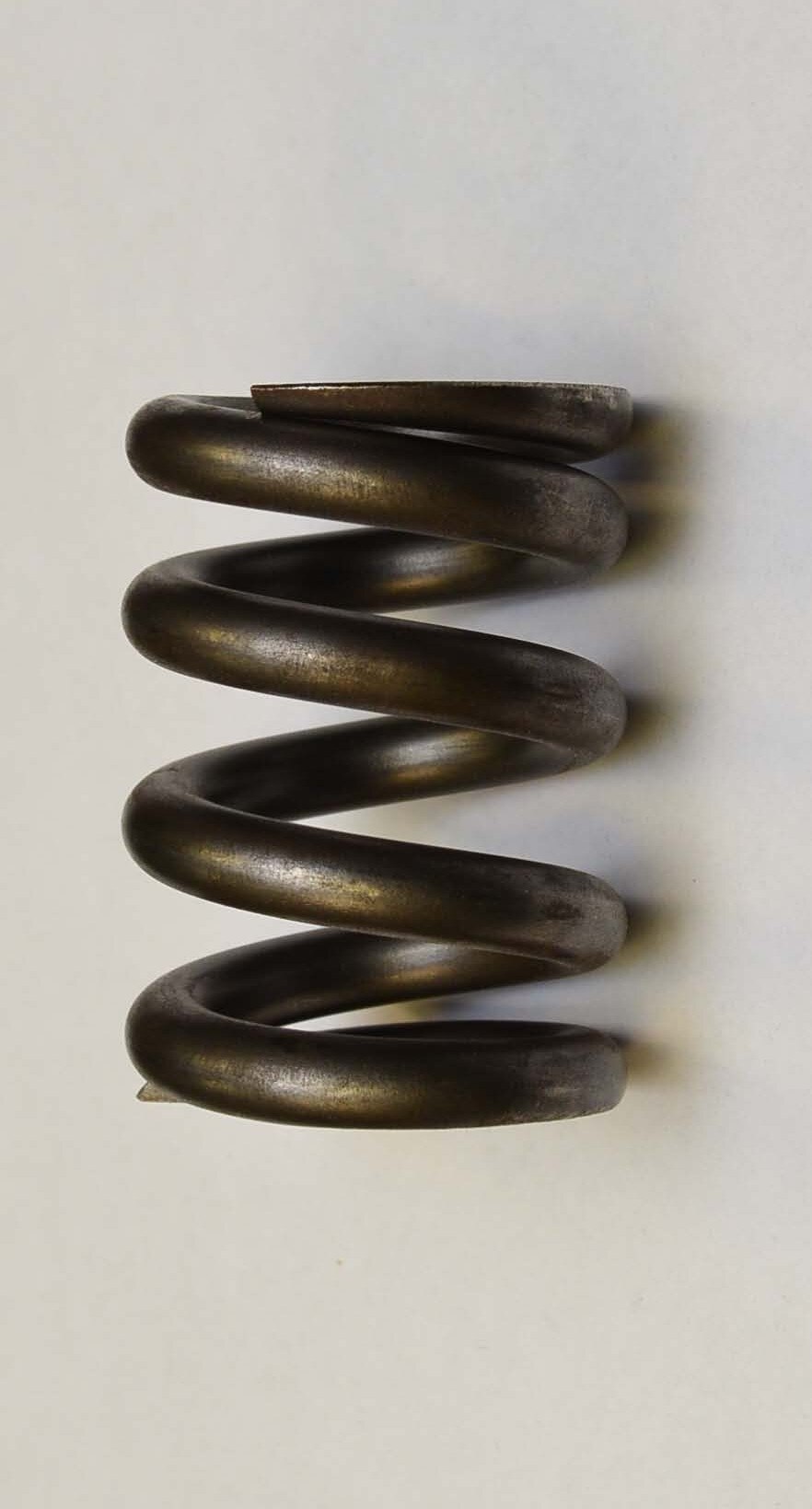
Spring Engineers of Houston are experts with years of experience in the design of many types of springs for various industries. We provide custom compression springs to meet our customer’s unique needs. We are proud to offer comprehensive spring design services regardless if you are starting from scratch or already have a design created and need help to refine it to perfection. Contact us today for assistance with the design of your spring or to discuss how we can help on your next project.
Common Forms of a Compression Coil Spring
Compression coil springs are helical springs with an open-coil configuration designed to store energy or to resist a force applied along the axis of the coil. The most common form of compression coil spring is a straight cylindrical coil spring with the ends squared (closed), and a common example is a ball point pen spring. The end coils may also be ground to improve squareness and reduce buckling. Squared and ground compression springs are normally supplied with a bearing surface of at least 270 degrees. For more options, visit our Compression Coil Spring Ends Treatments page.
Design of Compression Coil Springs
Compression coil springs are manufactured in conical, barrel or hourglass configurations. These forms of compression springs allow for reduced solid height. Compression springs are commonly wound with uniform spacing between the coils however, variable coil spacing can be used to achieve improved performance against buckling and surging. A compression spring with variable pitch assures a spectrum of frequency response as opposed to the single resonant frequency in a compression spring with constant pitch. Compression springs are often installed to operate over a rod or inside a hole. These installations help reduce buckling of the spring body. Design consideration should allow for the diametric increases of the compression spring body when the spring is compressed.
Extend the Lifespan of your Custom Compression Springs
Spring Engineers offers a large selection of coating and treatment options for all springs we produce. These added processes will increase the durability and resilience of your spring, especially in harsh or stressful environments. We also offer failure analysis and testing services that cover a broad scope of possible failure causes to identify the specific cause and point of failure. Our team of skilled failure analysts and analytical tools help you find the root of the problem and determine a cost-effective solution to prevent failure from happening again.
Spring Engineers of Houston is committed to offering quality and timely custom compression springs and other metal product manufacturing services. Contact our experts today for assistance in your spring design or for any questions.
Compression spring design considerations are numerous. Spring Engineers can assist you in your design efforts if you just provide a few basic spring design parameters. See our Compression Spring Worksheet in the "downloads" section. An effective compression spring design has four operating requirements to satisfy. Energy, Space, Environment and Service. Mix these operating specifications well, run them through a quality spring design program and you’ll have the best spring possible for your application.
Compression spring design considerations are numerous. Spring Engineers can assist you in your design efforts if you just provide a few basic spring design parameters. See our Compression Spring Worksheet in the "downloads" section. An effective compression spring design has four operating requirements to satisfy. Energy, Space, Environment and Service. Mix these operating specifications well, run them through a quality spring design program and you’ll have the best spring possible for your application.